The item is in a remote warehouse, delivery time is 5-7 business days. More info
Delivery options - Select at checkout
Shipping @price - GLS
12,00
EUR
130,89
Incl. VAT 163,61
Total incl. delivery
178,61
Add to list
The function requires that you are logged in. Create a user and use our smart list system to keep track of future purchases, regular purchases or wish lists.
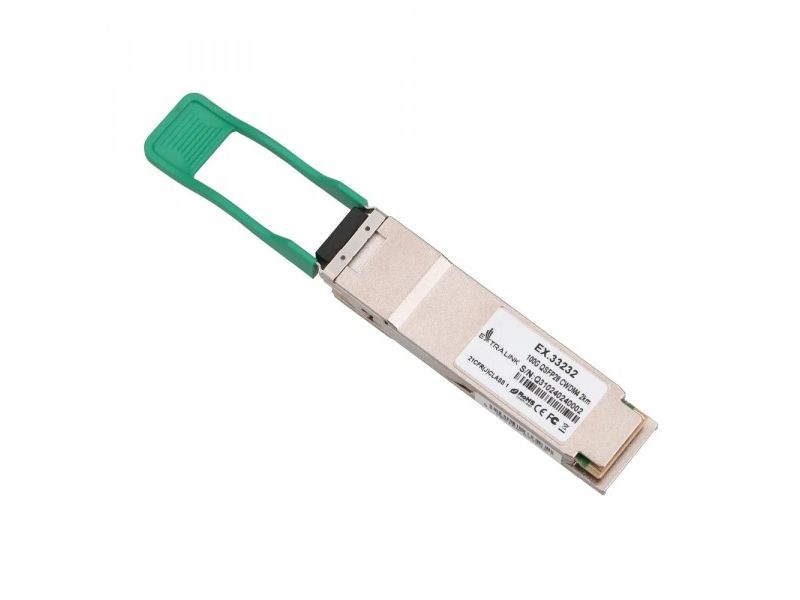
The Extralink QSFP28 module is an innovative solution that enables the construction of stable and efficient fiber optic connections. Offering a bandwidth of up to 100 Gb/s, it contributes to optimizing network infrastructure, supporting its development and reliability in the most demanding environments.
The QSFP28 module complies with the 100 Gigabit Ethernet standard, making it an ideal choice for applications requiring significant bandwidth. With data transmission speeds of up to 100 Gb/s, this solution represents a significant advancement compared to earlier standards such as QSFP+ (40 Gb/s) or SFP+ (10 Gb/s). This allows for seamless transmission of large volumes of data, which is crucial in today's networks where bandwidth demand is constantly increasing. Utilizing this module ensures that the network is prepared for future challenges related to data transfer.
The product is designed to work exclusively with Singlemode fiber optics. This feature enables relatively long transmission ranges, which is particularly important when connecting remote points in the network, such as data centers, main distribution nodes, or buildings spread over large areas. This allows installers to create connections covering significant distances without signal quality loss, making the infrastructure more flexible in design and implementation.
The item is known under the following item numbers in our system
EAN:
5906168633232
SKU:
EX.33232
SKU:
DNXGGMLMERMMHH
Why do I find that the same product is available on different item numbers?
Manufacturers often release the same product with different item numbers, typically just different versions of the packaging. For example, the packaging may be targeted at different countries.
We try our best to unify the products, but it can happen that the same product appears on different item numbers in our system.