The item is in a remote warehouse, delivery time is 3-4 business days. More info
Delivery options - Select at checkout
Shipping @price - GLS
12,00
EUR
99,03
Incl. VAT 123,79
Total incl. delivery
138,79
The function requires that you are logged in. Create a user and use our smart list system to keep track of future purchases, regular purchases or wish lists. Create user Login
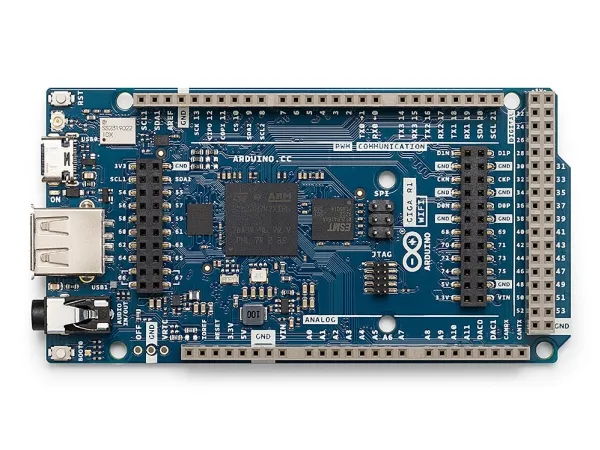
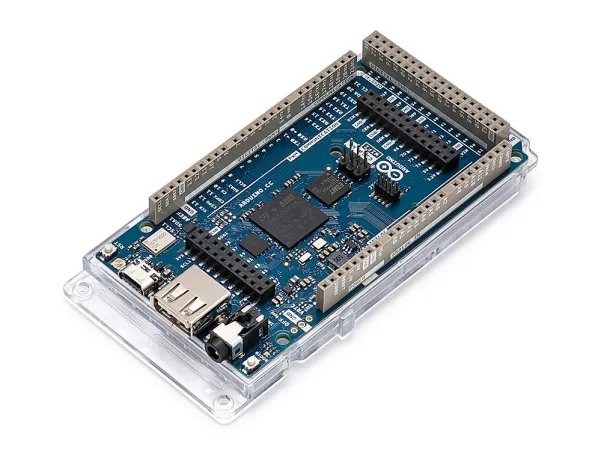
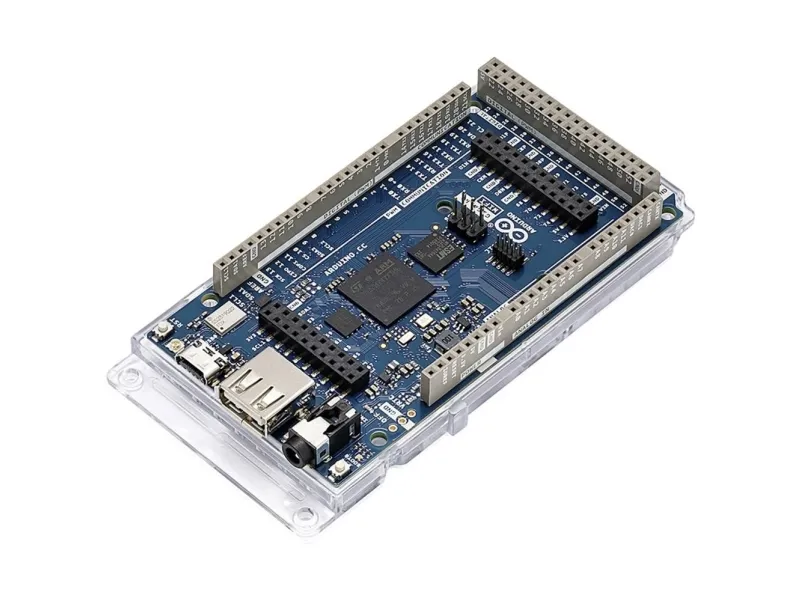
The Arduino GIGA R1 WiFi is designed for ambitious makers who want to step up their game. It levels the playing field for gamers, artists, sound designers and anyone coming to the tech world with big ideas on a budget – because it packs advanced features into an accessible component, with the same form factor as our popular Mega and Due.
Let’s break down all the powerful features of this board.
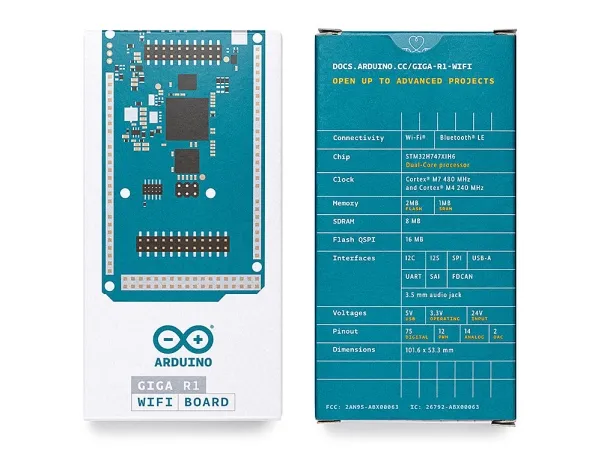
Microcontroller (STM32H747XI): This dual core 32-bits microcontroller allows you have two brain talking to each other (a Cortex®-M7 at 480 MHz and a Cortex®-M4 at 240 MHz) you can even run micropython in one and Arduino in the other.
Wireless communication (Murata 1DX): Whether you prefer Wi-Fi® or Bluetooth®, the GIGA R1 WiFi got you covered. You can even quickly connect to the Arduino IoT Cloud and keep track of your project remotely. And if you are concerned about the security of the communication, the ATECC608A keeps everything under control.
Hardware ports and communication: Following the legacy of the Arduino Mega and the Arduino Due, the GIGA R1 WiFi has 4 UARTs (hardware serial ports), 3 I2C ports (1 more than its predecessors), 2 SPI ports (1 more than its predecessors), 1 FDCAN.
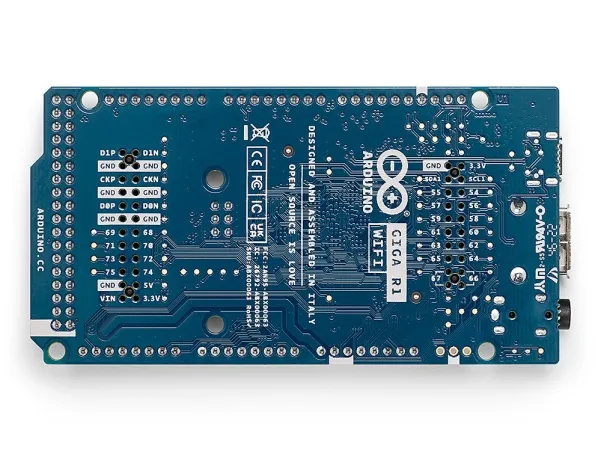
GPIOs and extra pins: We wanted to keep the same form factor of the Mega and the Due, so you can easily adapt your custom made shields to the GIGA R1 WiFi (remember this board works at 3.3V though!) and we added extra headers to access extra pins, leaving the total count to 76 GPIO pins, and the best part, you can access them from underneath, so keep your project as it is and just think on how to expand it. Also, we added two new pins: a VRTC so you can connect a battery to keep the RTC running while the board is off and an OFF pin so you can shut down the board.
Processor frequency
480 MHz
Processor manufacturer
ARM
Processor cores
2
RAM capacity
1 MB
Flash memory
2 MB
Wi-Fi
Yes
Ethernet LAN
No
USB version
2.0
Wi-Fi standards
802.11b, 802.11g, Wi-Fi 4 (802.11n)
Bluetooth
Yes
Bluetooth version
4.2
Bluetooth Low Energy (BLE)
Yes
Number of digital I/O pins
76
Number of analog I/O pins
12
PWM digital I/O pins
12
UART
Yes
I2C interface
Yes
SPI interface
Yes
Board dimensions
53 x 101 mm
The item is known under the following item numbers in our system
EAN:
7630049203266
Why do I find that the same product is available on different item numbers?
Manufacturers often release the same product with different item numbers, typically just different versions of the packaging. For example, the packaging may be targeted at different countries.
We try our best to unify the products, but it can happen that the same product appears on different item numbers in our system.