EUR 0,00
(Delivery cost: 0,00)


The function requires that you are logged in. Create a user and use our smart list system to keep track of future purchases, regular purchases or wish lists.
The epi-fluorescence attachment is used to employ the fluorescence technique.
The fluorescence technique is based on the ability of substances to emit light when excited by the light of a certain wavelength. Some specimens exhibit autofluorescence, while others should be treated with fluorochromes.
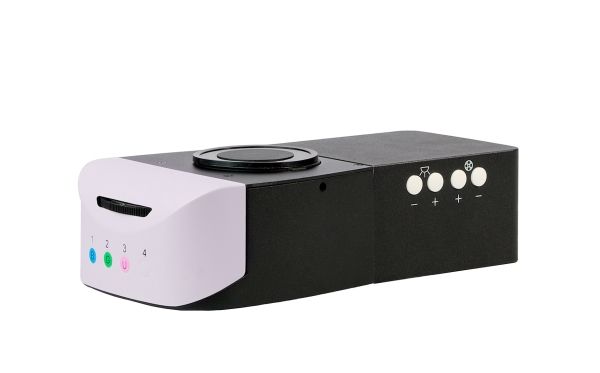
The attachment is mounted into the optical path between the microscope head and stand. There is a 4-position rotating turret inside the attachment with three broadband fluorescence filters of different wavelengths: blue (В), green (G), and ultraviolet (UV). The required filter is introduced into the optical path by clicking the button. One button on the attachment rotates the turret to the next filter clockwise, and the other one rotates the turret counterclockwise. One position of the turret corresponds to brightfield observations in transmitted light.
The excitation light sources are LEDs. The LEDs instantly reach the brightness set by the user, do not heat up during prolonged use, and switch off quickly, if necessary. This makes it easy to switch from the brightfield technique to fluorescence and back again. LED brightness is adjusted by way of two other buttons that are located in the same control area as the turret buttons. The LED lifetime is 50,000 hours. For higher education, it is recommended to choose LED-based fluorescence as it is low-maintenance and the safest.
To enable the fluorescence technique, use the MAGUS Epi-FL04M LED attachment together with the MAGUS PlanF S-Apo fluorescent objective set. The plan semi-apochromatic fluorescent objective enhances the microscope’s resolving power and reduces chromatic and spherical aberrations. The image in the eyepieces and through the digital camera is cleaner, has more contrast, and it is brighter than with a regular plan achromatic objective.
The high numerical aperture of fluorescent objectives enhances the microscope’s resolving power, but at the same time, it reduces the depth of field. Therefore, for transmitted light observations, we recommend using regular objectives from the microscope set with a greater depth of field.
Compatibility:
Package:
| Brand | MAGUS |
| Warranty | 2 years |
| EAN | 5905555026176 |
| Excitation light source | 3W LEDs |
| Fluorescence filter: filter type, excitation wavelength/dichroic mirror/emission wavelength | blue (B), 460–495nm / 505nm / 510nm; green (G), 510–550nm / 570nm / 575nm; ultraviolet (UV), 330–385nm / 410nm / 420nm |